How Oracle’s “Efficiency” Upgrade Siphoned $9 BILLION From The VA

Oracle's stock saw a jump earlier this year in April after landing fresh contracts with the USDA and Department of Defense, proof that nothing says “we trust you with sensitive government information" quite like a track record of... well, let's call it “mixed results." As the database giant continues its aggressive pursuit of taxpayer money, it seems like an excellent time to revisit their most recent marquee federal project: a $10 billion contract to modernize the VA's healthcare records system. Spoiler: it did not go well.
For decades, the VA ran on VistA, a homegrown electronic health record system developed in-house during the 1980s when “cutting edge" meant a floppy disk that could double as a dinner plate. I’ll give it some credit, VistA was pretty revolutionary for its time. It basically pioneered digital medical records before most hospitals even knew what a computer was. But by the 2010s, it had a fatal flaw: it couldn't talk to the Pentagon's systems.
A database of the medical records of all the king’s horses and all the king’s men that couldn’t be tapped into by the men in black was as good as useless. Remember, this was at the height of NSA phone-tapping conspiracy memes and drone tech hobbyism, not to mention the infancy of emerging tech behemoths like TikTok. At this stage, the government was well aware that when it came to data, more was better. It likely viewed its active security arm’s inaccessibility to the very relevant medical archive of its retired military personnel as a key data disadvantage.
When service members transitioned from active duty to veteran status, their medical records didn't follow, which forced newly discharged veterans to recreate their entire medical history from memory, often leading to dangerous gaps in care. Worse, VistA had splintered into 130+ customized versions across different VA facilities (let’s give it up for states’ rights!), each site essentially speaking its own dialect of the same language. The solution seemed obvious: get the VA and Department of Defense on the same page. In 2017, the VA announced it would adopt the same Cerner Millennium platform the DoD was using, promising seamless record transfers and 21st-century care. The contract was worth a juicy $10 billion over ten years.
What could possibly go wrong?
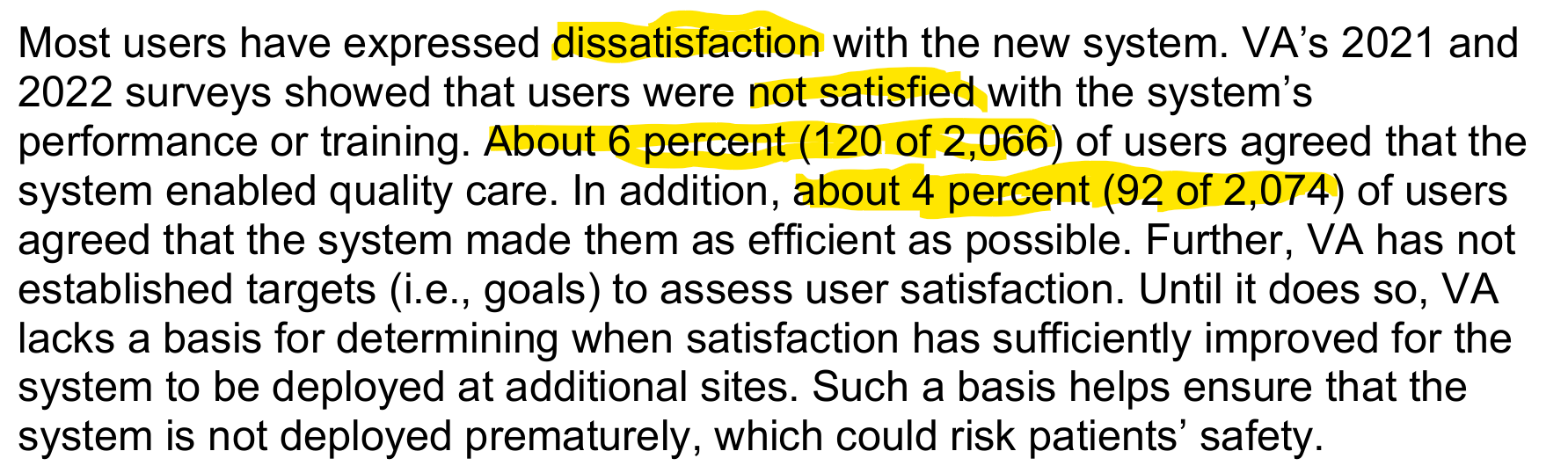
(GAO, 2023).
The Damage
The Cost
At a burn rate of $9.42 billion for roughly 6 deployments, rolling this disaster out to all 172 VA medical centers would cost approximately $269 billion (nice) and take roughly 143 years. For reference, that's:
More than the GDP of Finland
Enough time for the project manager’s great-great-great-grandson to inherit the position
Long enough to see the fall and rise of several empires, we could be on America 4 by then
The failure wasn't mysterious, it was methodological. The VA awarded a no-bid contract to Cerner without checking if their 1980s-era hospital infrastructure could even run the damn cloud software! The Inspector General found they'd underestimated costs by up to $2.6 billion because—and this is a direct quote from the OIG—“at the beginning of the program the focus was on the EHRM contract and the system itself, rather than infrastructure."
VA staff weren't even told about infrastructure requirements until after the ink had dried on the contract. Ignoring DoD's guidelines that facilities needed upgrades completed six months before they went live, the VA rushed deployment to Mann-Grandstaff in October 2020. The system immediately failed and sent 11,000+ medical orders vanishing into an “unknown queue," a hiccup that Cerner knew about but never disclosed. Staff training was so poor that managers falsified proficiency scores (showing 89% when reality was 44%), and one pharmacy had to quadruple staffing just to keep up. The OIG documented 149 patient harm events, with some nurses being “driven to tears" by the unusable software.
The program is currently “paused" which is government speak for “Oh God, oh fuck, what did we just do?"
The Quantified Conclusion
The truly impressive part isn't that a $10 billion government IT project failed, that's practically a public-private cliché at this point. No, the impressive part is failing so spectacularly that you had to pause the entire operation after deploying to only 3.5% of intended sites, with user satisfaction scores that would make Windows Vista look beloved by comparison. Oracle’s approach to this project was charge for the fix without doing much fixing. Veterans are still waiting for a healthcare records system that doesn't actively make their doctors' jobs harder.
But at least we have really great data on exactly how much money you can light on fire before someone hits pause.
Note: This visualization was created using HTML5 Canvas, JavaScript, and a profound sense of disappointment in government procurement processes. All data sourced from U.S. Government Accountability Office Report GAO-23-106685 (2023).